
Potter County Court Records After Arrest
A Potter County arrest normally starts in the jail system and then moves toward judicial review. The Potter County Sheriff's Office public records page links the daily jail roster and book-in report. Those PDFs can show the name, booking number, SO number, charge text, court or agency reference, bond amount, and status code. They do not replace a court file. A court record starts when the proper prosecutor files a complaint, information, indictment, or related pleading in the court that has jurisdiction over the charge.
Felony prosecution in Potter County is handled by the 47th Judicial District Attorney's Office, which represents the State in felony cases from Potter and Armstrong Counties. Class A and Class B misdemeanor prosecution goes through the Potter County Attorney and the two County Courts at Law. Class C matters outside Amarillo city limits may route to Justice of the Peace courts. Booking and custody information belongs with the sheriff, while court filings and docket records belong with the District Clerk, County Clerk, or the court that issued the case.
For custody status, use Potter County jail inmate records. For booking photos, use Potter County jail mugshots. Court records after a jail arrest focus on the charge filed in court, the case number, hearings, bond orders, plea or trial status, and final disposition.
Find Potter County Court Records
The county open-records page links the Potter District and County Courts Tyler portal for basic civil and criminal case information. A search is strongest when the jail roster gives a case number or court code, but a name search can help when a case number has not been found. Recent arrests can lag. A person may appear in the book-in report before the prosecutor has filed a case or before the clerk index has enough detail to search.
The Potter County open records page also explains routing. District court records go to the District Clerk. County Courts at Law and constitutional county court records go to the County Clerk. Justice of the Peace records stay with each JP court. If the case is too new for the portal, the practical next step is to use the booking date, name, and charge text from the roster, then ask the proper clerk whether a case has been opened.
- Open the Potter court portal and search by defendant name, using the spelling from the jail roster.
- If the roster shows a case number, court prefix, or agency reference, search that value as the stronger identifier.
- Open the matching case and compare the defendant name, charge date, court level, and filed charge list.
- Check each charge status separately because one Potter arrest can produce several charge lines with different outcomes.
- Request copies from the clerk when the portal summary is not enough for the document needed.
The District Clerk lists the criminal department at (806) 379-2313 and criminalinformation@co.potter.tx.us. The County Clerk lists the court department at (806) 379-2284. Those offices handle clerk records, not jail release decisions.
| Portal Field | Use | Potter County Notes |
|---|---|---|
| Name or party search | Find a case when no number is known. | Use the roster spelling and add a date range for common names if the portal exposes one. |
| Case number | Best match when available. | Roster lines may show district, county, JP, municipal, federal, or other agency references. |
| Case type or location | Filter by court level. | The county portal covers District and County Courts; JP records may need the specific JP court. |
| Date range | Narrow recent arrest results. | Use the booking or charge date from the roster as a starting point. |
| Search and reset controls | Run or clear the query. | The Tyler portal is dynamic, so labels may shift as the county updates the interface. |
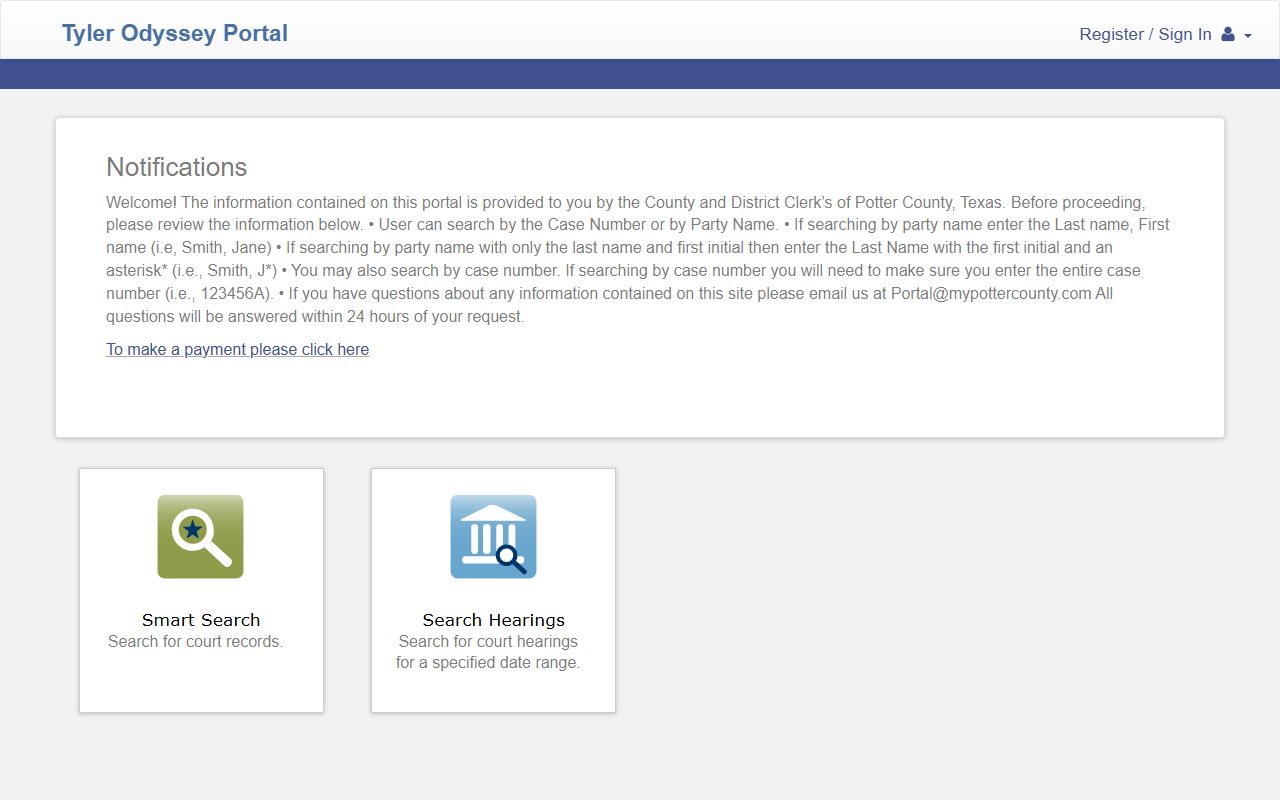
The Potter court portal screenshot below shows the county-linked case search used for basic case information.
Use the portal as a starting index, then rely on the clerk for filed documents, certification, and copy requests.
Charging Documents After Arrest
The jail roster may show the arrest charge before a prosecutor has made a filing decision. Potter County's research is clear on this point: a roster charge can be pending, refused at intake, no probable cause, changed, or replaced by a court-filed charge. A formal court record forms around a charging document. The charging document tells the court what offense the State alleges, which defendant is accused, and which court should hear the matter.
Felony matters can move from law-enforcement presentation to grand jury action through the District Attorney. Misdemeanor matters are handled by the County Attorney side and the county-level courts. The title of the charging document matters because it helps a reader understand why a case may not appear online right after arrest.
| Document | Who Uses It | What It Means |
|---|---|---|
| Complaint | Often an officer or prosecutor | Alleges facts that support a criminal charge and may start early court action. |
| Information | Prosecutor | A prosecutor-filed charge, commonly used for many misdemeanor cases and some felony paths allowed by law. |
| Indictment | Grand jury | A grand-jury charging document often used for felony prosecution in district court. |
Charging documents are not the same as police reports. They also are not the same as the sheriff's daily roster. A copy of a complaint, information, indictment, judgment, or order should be requested from the correct clerk, not from the jail records desk.
Potter County Charge Status
Charge status is the place where many jail-arrest searches go wrong. Potter County roster entries can show PENDING DISPOSITION, SENTENCED TDCJ, SENTENCED COUNTY TIME, SENTENCED STATE JAIL, CASE REFUSED AT INTAKE, NO PC, BONDED, RELEASE HOLD PER AGENCY, FOUND INCOMPETENT/INSANE, and other status text. Those labels are custody and case-status clues. They are not a complete judgment of guilt.
When the court record opens, charges can be filed as listed, amended, reduced, added, dismissed, or resolved by plea or trial. One arrest can also have a local charge plus a parole hold, municipal warrant, federal reference, or out-of-county hold. Read the court docket and every charge line before drawing a conclusion.
| Status | Plain Meaning | Where to Confirm |
|---|---|---|
| Pending disposition | The charge has not reached a final court outcome. | Case portal, clerk, or prosecutor filing. |
| Case refused at intake | The intake process did not accept that charge as filed. | Clerk or prosecutor, especially if other charges remain. |
| No PC | No probable cause was found for that entry. | Court order or clerk record. |
| Bonded | Release occurred or bond was posted on that line. | Jail records and court bond documents. |
| Release hold per agency | Another agency controls or affects release. | Jail, warrant deputy, or holding agency. |
| Sentenced TDCJ or state jail | The case has moved toward state custody after sentencing. | TDCJ locator, court judgment, and clerk record. |
Bond After Potter County Arrest
Bond in Potter County has both a court side and a jail side. Texas Code of Criminal Procedure Chapter 17 governs bail and bonds. The Potter roster can list bond amounts by charge line, but the amount alone does not answer every release question. A person may have one charge with a listed amount and another line that shows a hold, sentence, parole issue, or no-bond status.
PCSO states that daily magistration and arraignment hearings occur at 11:00 a.m. and are streamed from the detention center page. Magistration is the early court appearance where rights, charges, and bond can be addressed. If a bond question affects actual release, confirm it with the detention center, records staff, a clerk, or a lawyer. A 0.00 amount on a public roster should not be read as automatic release.
| Bond Term | How It Works |
|---|---|
| Cash bond | Money is posted directly under court rules and may be applied to court obligations. |
| Surety bond | A licensed bail bond company posts the bond and takes responsibility for appearance. |
| PR bond | Personal recognizance means release on a written promise and conditions, without posting the full amount. |
| No-bond hold | No monetary release is available on that line until a judge or holding agency changes status. |
| Detainer | Another agency asks the jail to hold the person or give notice before release. |
Warrants Before Court Records
A warrant can be the reason a Potter County arrest happens. Texas Code of Criminal Procedure Chapter 15 covers arrest warrants and related arrest authority. PCSO's public records page links an active warrant report and warns people who believe they have a warrant to contact a warrant deputy immediately. The sheriff lists Deputy Wagoner at (806) 379-2980 and Deputy Sanchez at (806) 379-2941 for active warrant questions.
After arrest, a warrant can appear on the jail roster as a charge, hold, or agency line. Bench warrants and capias entries often arise from missed court dates or failure to follow court orders. A search warrant is different; it authorizes a search and is not normally a custody lookup record. When a warrant is tied to a court case, search the Potter court portal and contact the clerk for the court that issued it.
Charge vs Conviction
A Potter County charge after arrest is an accusation. A conviction is a final outcome based on a guilty plea, finding of guilt, or verdict. The difference is not just wording. It affects how a record should be read, whether bond is still in play, and whether the case has a sentence, probation term, dismissal, or other disposition.
| Question | Charge | Conviction |
|---|---|---|
| Stage | Filed or alleged after arrest. | Final result after plea, trial, or judgment. |
| Proof | Based on probable cause or prosecutor filing. | Based on plea or proof beyond a reasonable doubt. |
| Where seen | Roster, complaint, information, indictment, docket. | Judgment, sentence, docket disposition, TDCJ record if prison follows. |
| Can change | May be amended, reduced, or dismissed. | Can be appealed or later affected by court relief, but it is not a mere allegation. |
Certified Potter County Records
Portal summaries are useful, but certified court records come from a clerk. The District Clerk copy page says written requests should include the cause number and documents requested. It lists uncertified copies at $0.50 per page, certified copies at $1 per page, a $30 deposit for written requests, and a $5 search fee required by state law. Requests may be made in person or by mail to the District Clerk, Potter County, P.O. Box 9570, Amarillo, TX 79105.
For county-level criminal cases, the County Clerk's court department is the better starting point. For district felony matters, use the District Clerk criminal department. The District Clerk page also notes downtown parking disruption tied to demolition near 5th and Fillmore, so in-person records visitors should plan ahead before going to the courthouse area.
Sealed vs Expunged Records
Texas public access starts with the Public Information Act, Government Code Chapter 552, but access has limits. Active investigations, juvenile records, sealed records, expunged matters, and confidential law-enforcement information may be withheld or restricted. Texas Code of Criminal Procedure Chapter 55A governs expunction of qualifying criminal records.
| Question | Sealed | Expunged |
|---|---|---|
| Public visibility | Hidden from most public access after a court order. | Removed or destroyed as directed by court order. |
| Government access | Some justice agencies may retain limited access. | Access is more restricted and depends on the expunction order and law. |
| Common reason | Eligible nondisclosure or restricted access relief. | Eligible dismissal, acquittal, no charge, or other Chapter 55A path. |
| Where to start | Court order and clerk record. | Court order under Chapter 55A and agency compliance. |
Important: Public lookup results are not consumer reports and must not be used for credit, employment, housing, insurance, or other FCRA-covered decisions.